
The Deadline Decision: When Integrity Costs You Time
How AI makes looking competent effortless, and integrity expensive

It’s 4:47 PM on a Thursday.
Your presentation to the executive team is at 8:00 AM Friday.
You’ve been working on this analysis for three weeks, but life happened. Emergencies, interruptions, competing priorities. The research isn’t as deep as you wanted. The conclusions aren’t as solid as they should be. You know there are gaps.
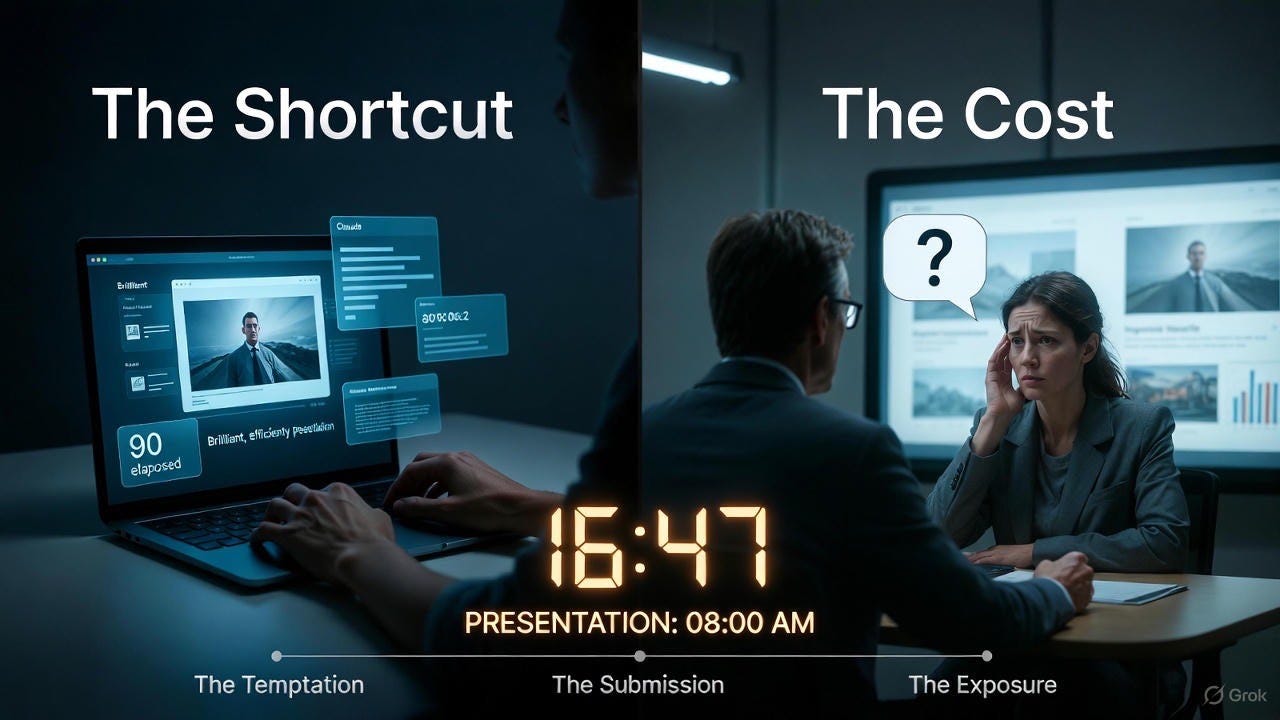
You open ChatGPT and paste in your rough notes and type: “Turn this into a compelling executive presentation with clear recommendations and supporting data analysis.”
Ninety seconds later, you have 24 slides that look brilliant.
The language is crisp. The structure is logical. The recommendations sound authoritative. It looks exactly like the kind of analysis a senior strategist would produce.
There’s just one problem: You can’t defend half of it.
You know enough to know it sounds right. But you don’t know enough to know if it is right. And tomorrow morning, when the CFO asks you to explain your methodology, you’re going to stumble.
You have three choices:
A) Submit it anyway. Hope nobody drills down. Claim brilliance you’re borrowing.
B) Be honest. Tell your boss you need another week. Risk looking incompetent.
C) Use what AI gave you as a framework, work through the night to understand it deeply, clearly mark what’s solid analysis versus preliminary thinking, and present something you can actually defend.
Most people choose A.
Because most people have never learned that integrity under pressure isn’t a personality trait.
It’s a system.
And they don’t have the system built.
Why Deadlines Break People
Here’s what 30 years in tech has taught me about deadline pressure:
Deadlines don’t create your character. They reveal it.
When you have plenty of time, it’s easy to do the right thing. Easy to be thorough. Easy to maintain standards. The friction is low, the stakes feel distant, and your better nature has room to operate.
But deadlines collapse that space.
Suddenly, the friction is high and the stakes are immediate. Your worst impulses have an argument: “Just this once. Nobody will know. You can fix it later. The pressure isn’t your fault.”
And that’s when you find out who you actually are.
Not who you think you are when you’re relaxed and comfortable.
Who you are when it costs you something to do the right thing.
Before AI, deadline pressure still revealed character. But there was built-in friction that gave you time to reconsider. If you were going to cut corners, you had to invest effort into the shortcut. Copy-paste someone else’s work manually. Retype their analysis. Restructure their argument.
That effort created natural checkpoints. Moments where your conscience could intervene. Where the cognitive dissonance would surface. Where you’d have time to think: “Is this really who I want to be?”
AI removed those checkpoints.
Now the gap between temptation and execution has collapsed to seconds.
Type prompt. Get output. Submit.
Three seconds from thought to compromise.
And most people aren’t ready for that level of acceleration.
The Real Deadline Crisis
The crisis isn’t that deadlines exist.
The crisis is that AI makes it effortless to look competent without being competent.
And most people can’t resist effortless.
Especially when they’re tired, stressed, and facing consequences for missing a deadline.
Let me show you what actually happens:
The First Compromise
You use AI to fill a gap in your knowledge.
You tell yourself: “I’ll learn this properly later. Right now I just need to deliver.”
The presentation goes well. Your boss is impressed. You got away with it.
Lesson learned: Shortcuts work.
The Second Compromise
Two weeks later, another deadline. Another gap.
This time you don’t even hesitate. You go straight to AI.
“Just this once” has become “just like last time.”
The presentation goes well again. More praise. Still no consequences.
Lesson reinforced: Shortcuts are efficient.
The Third Compromise
A month later, you’re not even bothering to learn the material first.
Why would you? AI is faster, and nobody’s checking anyway.
You’ve gone from “using AI to fill gaps” to “using AI to replace thinking entirely.”
New pattern established: This is just how you work now.
The Inevitable Exposure
Six months in, you’re assigned a major project based on your “proven track record.”
The stakes are higher. The scrutiny is greater. The questions are deeper.
And you can’t answer them.
Because you never actually learned any of it.
You were just outsourcing to AI and claiming the credit.
Now the gap between your reputation and your capability is exposed.
And the cost is catastrophic.
What The Deadline Actually Costs
When you choose the shortcut under deadline pressure, you think you’re trading:
Time for efficiency -> Effort for results -> Process for outcomes
What you’re actually trading:
Competence for dependency — Every time you use AI as a crutch instead of an amplifier, you get worse at your craft, not better.
Reputation for exposure risk — Every false success raises the stakes for the next one. You’re building a house of cards.
Long-term capability for short-term convenience — You’re mortgaging your future self to bail out your present self.
Integrity for anxiety — You know you’re faking it. That knowledge corrodes you. The dread compounds.
And here’s the part nobody warns you about:
The interest rate on these trades is exponential.
That dependency compounds. Your skills atrophy. Your confidence erodes.
That exposure risk compounds. Every deadline that “worked” raises expectations you can’t meet.
That anxiety compounds. You’re waiting for the moment someone asks the question you can’t answer.
You think you’re saving time. You’re accumulating debt.
The Honest Timeline Framework
Here’s what 30 years taught me works better than shortcuts:
When facing a deadline you can’t meet with integrity:
Step 1: Assess Reality
Ask yourself three questions:
Can I deliver quality work by this deadline? (Not “good enough”—actual quality)
What would it take to deliver quality work? (Time, resources, help)
What’s the cost of delivering mediocre work versus asking for more time?
Be brutally honest.
Not optimistic. Not hopeful. Honest.
Step 2: Communicate Early
If you can’t meet the deadline with integrity:
Go to your stakeholder immediately.
Not the day before. Not the morning of.
The moment you know.
Say this: “I want to give you quality work, not rush-job work. To do that well, I need [specific amount of time/resources/help]. Here’s why, here’s what I’ve done so far, and here’s what the extra time gets you. Would you rather have it [original deadline] at 60% quality, or [new deadline] at 95% quality?”
Most people never do this because they think it makes them look incompetent.
What it actually does: It makes you look like someone who understands quality and manages expectations honestly.
Step 3: Use AI Responsibly Within Constraints
If they say “No, we need it by the original deadline”:
Use AI to amplify what you can do, not to fake what you can’t.
Let AI structure your existing thinking (not replace it)
Use AI to explore angles you haven’t considered (then verify them)
Have AI identify gaps in your logic (then fix them yourself)
Let AI draft sections based on your outline (then rewrite them extensively)
The rule: Only include what you can defend.
If you can’t explain it, it doesn’t go in.
If you can’t verify it, it doesn’t go in.
If you can’t stand behind it, it doesn’t go in.
Step 4: Mark What’s Preliminary
If you have to include analysis you’re not 100% confident in:
Say so explicitly. “Based on available data, preliminary analysis suggests X. This should be validated with [specific next steps] before final decision-making.”
This is not weakness. This is intellectual honesty.
It shows you understand the difference between solid conclusions and working hypotheses.
And it protects you when someone drills down.
Step 5: Document the Gap
Keep a record of:
What you wanted to do with more time
What you actually delivered
What shortcuts you took (if any)
What you learned from the pressure
This isn’t for anyone else. This is for you.
Because next time (and there will be a next time) you’ll have a clearer picture of how to avoid the same situation.
The 72-Hour Rule
Here’s a system that works:
Any time you use AI to help meet a deadline:
Within 72 hours, go back and actually learn the material AI helped you with.
Not skim it. Not review the output.
Actually learn it.
Understand the methodology.
Verify the conclusions.
Fill the knowledge gaps.
Do the work you would have done if you’d had more time.
Why this works:
You maintain competence — You’re learning what AI taught you
You reduce dependency — Next time, you won’t need AI for this
You sleep better — You can now defend what you presented
You compound capability — You’re using pressure as a learning opportunity
The deadline forced the shortcut. The 72-hour rule prevents it from becoming a pattern.
What This Looks Like in Practice
Let me show you two people facing the same deadline:
Person A: The Shortcut
Thursday 4:47 PM: Realizes presentation isn’t ready
Thursday 5:00 PM: Prompts AI to generate the whole thing
Thursday 5:30 PM: Submits it, feels relieved
Friday 8:00 AM: Presents confidently
Friday 8:45 AM: CFO asks methodology question, stumbles, deflects
Friday 9:00 AM: Team notices the gap, says nothing
Next deadline: Does it again, gap widens
Six months later: Exposed as incompetent, loses credibility
Trajectory: Accelerating toward catastrophic failure
Person B: The System
Thursday 4:47 PM: Realizes presentation isn’t ready
Thursday 5:00 PM: Assesses what’s possible with integrity
Thursday 5:15 PM: Emails boss: “I can deliver 70% quality tomorrow or 95% quality Monday. Here’s the trade-off.”
Thursday 5:30 PM: Boss says: “Give me what you have tomorrow, mark what’s preliminary, finish it Monday.”
Thursday 5:45 PM: Uses AI to structure existing thinking, not replace it
Thursday 11:00 PM: Delivers presentation that’s honest about what’s solid vs. preliminary
Friday 8:00 AM: Presents, clearly marks preliminary sections
Friday 8:45 AM: CFO asks question, answers confidently about solid sections, says “That’s one of the areas I’m validating Monday” for preliminary parts
Friday 9:00 AM: Team respects the honesty
Next deadline: Asks for time earlier, gets it
Six months later: Known for quality and honesty, gets promoted
Trajectory: Building toward sustainable excellence
Same deadline. Same pressure. Different system.
Person A chose convenience. Person B chose integrity.
Person A accelerated toward exposure. Person B compounded capability.
The tool didn’t determine the outcome. The system did.
The Question That Changes Everything
Before you submit anything created under deadline pressure, ask yourself: “If someone asked me to explain every claim in this work, could I?”
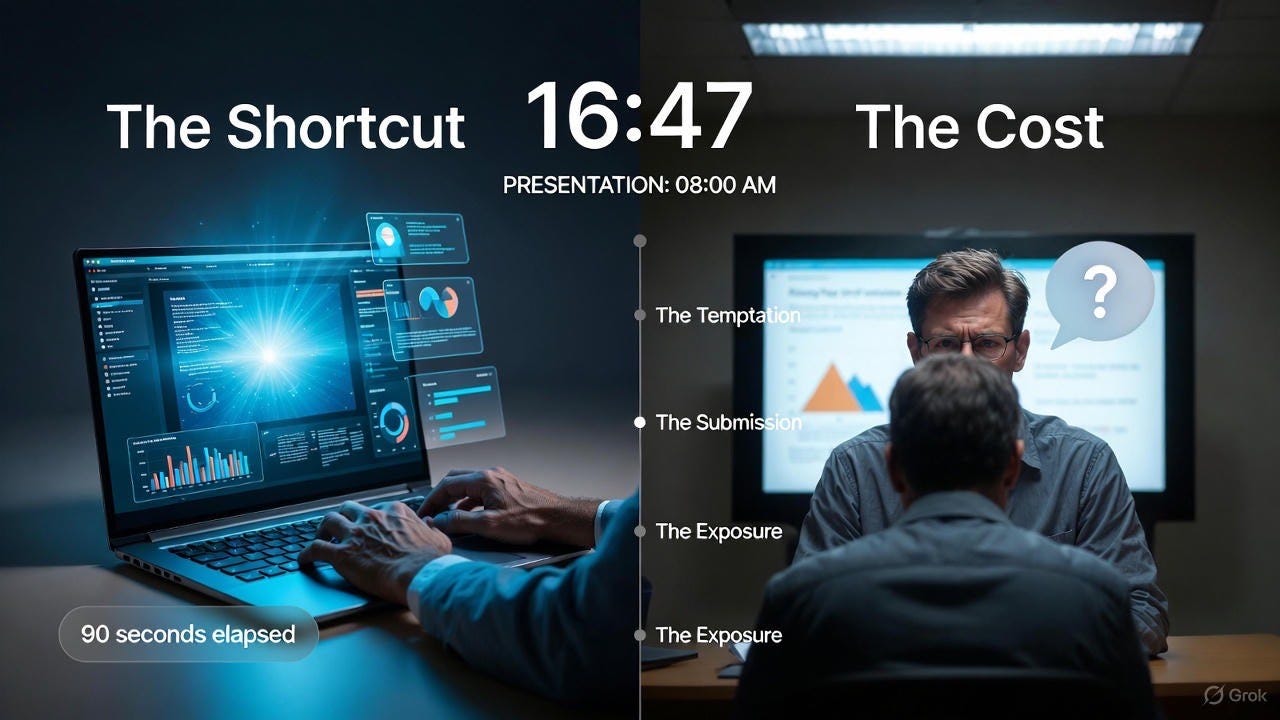
Not “Could I probably figure it out.” Not “Could I Google my way through it.”
Could I explain it right now, in detail, with confidence?
If yes: Submit it. You’ve used AI responsibly.
If no: Either fix that gap immediately, or mark those sections as preliminary, or ask for more time.
Those are your only ethical options.
Submitting work you can’t defend isn’t efficiency.
It’s fraud on an accelerated timeline.
And the timeline matters because the exposure comes faster now.
Before AI, it might take months or years for the gap to be revealed.
Now? Weeks. Sometimes days.
The question in the meeting that you can’t answer.
The follow-up project where you can’t replicate the quality.
The colleague who notices you can’t explain your own methodology.
The bill comes due faster than ever.
So you better make sure what you’re charging to that account is worth the price.
What To Do Right Now
This week, you will face a deadline that tempts you to compromise.
Maybe it’s already happening.
When that moment comes, use the Honest Timeline Framework:
Assess reality honestly
Communicate early
Use AI to amplify, not replace
Mark what’s preliminary
Learn the material within 72 hours
And ask yourself:
Is the time I’m “saving” worth the competence I’m sacrificing?
Is the convenience I’m choosing worth the exposure risk I’m building?
Is the credit I’m claiming worth the anxiety I’m creating?
Because deadline pressure reveals character.
And AI accelerates that revelation.
The only question is: What’s being revealed?
Coming on Wednesday
We’ve explored what happens when pressure is temporal—when you’re racing the clock. But there’s another kind of pressure that’s even more insidious.
Social pressure.
When nobody’s watching. When you could take credit and nobody would know. When attribution is fuzzy and you could blur the lines.
That’s when character gets tested most severely.
Because at least with deadlines, the pressure is external and acknowledged.
With attribution, the pressure is internal and secret.
And that’s where most people fail.
Not because they don’t know the right answer.
Because they’ve never built the system that makes the right choice automatic when no one’s watching.
This article is part two of a three part series:
Part One: The Deadline Decision: When Integrity Costs You Time
Part Two: The Attribution Temptation: When Nobody’s Checking
Part Three: The Competence Crisis: When You Realize You’ve Been Faking It
Thanks for reading T.S. Butler! Subscribe for free to receive new posts and support my work.