
AI Doesn’t Make You Creative—It Exposes Whether You Ever Were
What your AI output reveals about who you actually are

You typed “create a marketing campaign for my business” into ChatGPT. It gave you five paragraphs of corporate slop.
Generic value propositions. Vague calls-to-action. Language so bland it could’ve been written by a committee of insurance adjusters.
You posted it anyway… Because you were never creative to begin with.
”AI is the most honest mirror you’ll ever look into. It shows you exactly what you bring to the table. Your curiosity. Your discernment. Your taste. Your judgment. Or lack thereof.”
The Lie You’ve Been Telling Yourself
“AI makes everyone creative.”
No. AI makes creativity accessible. Different thing entirely.
Here’s what’s actually happening: You’re witnessing the democratization of production and mistaking it for the democratization of creativity. These are not the same thing. Production is mechanical—it’s the act of making something exist. Creativity is interpretive—it’s the act of making something matter.
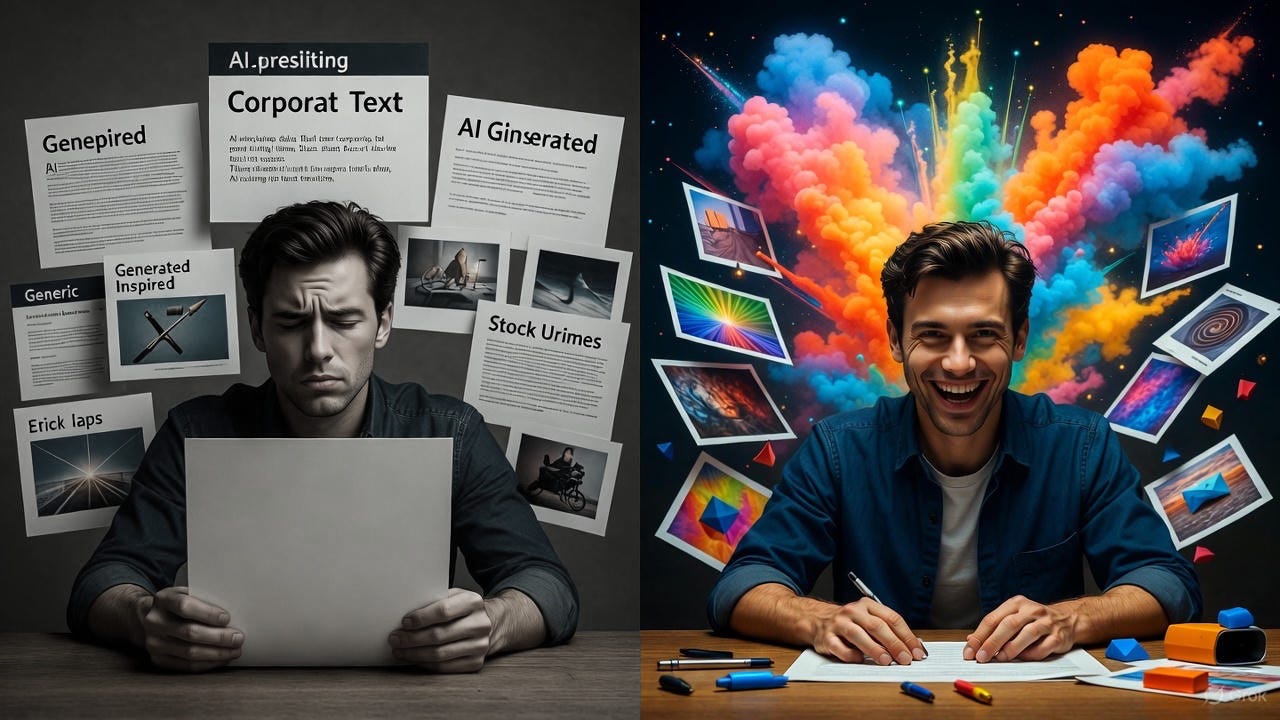
The printing press democratized production. Suddenly, anyone could produce a book. But it didn’t make everyone a Shakespeare. The camera democratized image capture. Anyone could take a photo. But it didn’t make everyone an Ansel Adams. The internet democratized publishing. Anyone could post content. But it didn’t make everyone a voice worth hearing.
AI is the latest tool in this lineage. It democratizes the ability to generate. But generation without discernment, without taste, without the capacity to recognize quality—that’s not creativity. That’s just noise with a veneer of sophistication.
And you can see this playing out everywhere. LinkedIn is drowning in AI-generated thought leadership that sounds profound but says nothing. Websites are filled with AI-written content that’s technically correct but spiritually empty. Marketing campaigns are being launched with AI-generated copy that hits all the checkboxes but moves nobody.
The tool reveals the person.
Give a paintbrush to Michelangelo, you get the Sistine Chapel.
Give a paintbrush to a toddler, you get finger paint on the walls.
The tool didn’t change. The person holding it did.
The Myth of AI-Generated Creativity
Let’s be precise about what AI actually does.
AI doesn’t create. It recombines. It takes patterns from millions of examples and synthesizes them into new configurations. That’s not creation—that’s sophisticated pattern matching. And there’s nothing wrong with that, but let’s not confuse it with the creative act.

True creativity involves:
Vision: Seeing something that doesn’t exist yet
Taste: Knowing when something is good enough to matter
Iteration: The willingness to refine until it’s right
Discernment: Understanding context, audience and purpose—deeply enough to make intentional choices
AI can help with execution. But it can’t replace any of these.
When you prompt AI, you’re not creating. You’re directing. And the quality of your direction reveals the quality of your thinking.
Two people. Same AI. Radically different results.
Person A prompts: “Write me a blog post about leadership.”
Person B prompts: “Write about the moment a leader realizes their team has stopped listening—not because they’re wrong, but because they’ve stopped earning attention. Open with a scene: the meeting where everyone nods but nobody engages. Show the leader’s internal recognition. Then dissect why attention is earned, not commanded. Make it sting.”
The first person gets 500 words of LinkedIn drivel. The second gets something that might actually change someone.
What’s the difference?
Person B knows what they’re looking for.
They have vision. They understand the emotional truth they want to capture. They can recognize quality when they see it. They’ll iterate until the output matches their internal standard.
Person A has none of that. They just want “content.” And that’s exactly what they get—content that fills space but changes nothing.
What Prompt Engineering Really Reveals
Your prompts are a window into your mind.
Lazy prompts reveal lazy thinking.
Vague prompts reveal vague understanding.
Generic prompts reveal no original thought whatsoever.
This is the part nobody wants to hear: AI is making your intellectual mediocrity visible at scale.
Before AI, you could hide behind effort. “I worked hard on this” was a defense. The hours you put in obscured the quality of thinking you brought to it. AI strips that away. Now the work product stands alone. And if your thinking was shallow, your output will be too—no matter how many hours the AI saved you.
When you type “make this better,” what you’re really revealing is: “I don’t know what ‘better’ looks like.”
When you accept the first output without iteration, what you’re really revealing is: “I have no standards.”
When you copy-paste AI slop directly into your work, what you’re really revealing is: “I was never interested in excellence. Just completion.”
And here’s the brutal part: Everyone can tell.
Your colleagues can tell.
Your clients can tell.
Your audience can tell.
Because AI-generated mediocrity has a signature. It’s technically proficient but spiritually hollow. It uses the right words but creates no resonance. It fills space but changes nothing.
You think you’re being efficient. You’re actually building a reputation for producing work that doesn’t matter.
The Mirror Before The Multiplier
Here’s the framework you need to understand:
AI doesn’t create. It amplifies.
It takes what’s already in you and scales it.
If you’re intellectually curious, AI helps you explore faster.
If you’re intellectually lazy, AI makes you efficiently lazy.
If you’re creatively bankrupt, AI helps you produce bankruptcy at scale.
If you have nothing to say, AI will help you say nothing louder.
This is why the same tool produces such wildly different results for different people. The tool is neutral. The person isn’t.
Think about what you’re actually bringing to the interaction:
Context: Do you understand the problem deeply enough to ask the right questions?
Discernment: Can you recognize quality when you see it?
Iteration: Are you willing to refine, redirect, improve?
Standards: Do you have an internal benchmark for “good enough”?
If you’re bringing depth, AI amplifies that depth.
If you’re bringing nothing, AI amplifies nothing.
The mirror shows you before the multiplier kicks in.
And most people don’t like what they see.
The Uncomfortable Case Study
Let me show you what this looks like in practice.
Two people are given the same task: Create a proposal for a new company initiative.
Person A:
Prompts: “Write a proposal for improving company culture”
Gets: 3 pages of generic corporate speak about “synergy” and “stakeholder engagement”
Submits it with minor tweaks
Result: Proposal gets filed away, nothing changes
Person B:
Spends 30 minutes thinking about the actual problem
Identifies: The issue isn’t “culture”—it’s that junior employees feel their ideas don’t matter
Prompts: “Help me structure a proposal that creates formal pathways for junior employees to pitch ideas directly to leadership, with clear evaluation criteria and feedback loops. The tone should acknowledge current frustrations without being accusatory.”
Gets a draft
Iterates 4 times, adding specific examples, refining language, strengthening the business case
Submits work they can defend in detail
Result: Proposal gets implemented, company changes
Same tool. Different person. Different outcome.
Person A used AI to avoid thinking.
Person B used AI to amplify thinking they’d already done.
The tool revealed who had something worth saying.
“But I Got The Result I Needed”
Did you?
Or did you get the result you settled for because you didn’t know how to demand better?
There’s a reason some people produce AI-assisted work that’s indistinguishable from brilliance while yours reads like it was written by a bot.
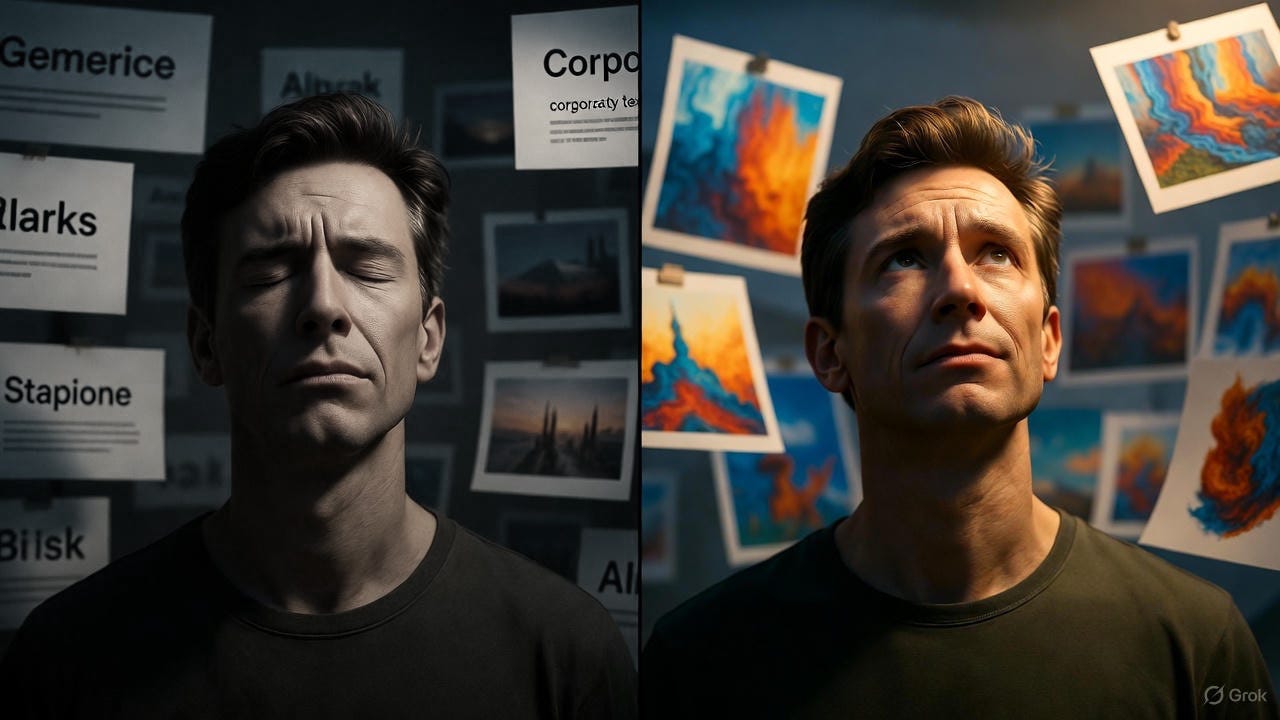
Because theirs wasn’t written by the bot.
It was directed by someone who knew what they wanted.
Someone with:
Clear vision of the end goal
Deep understanding of the subject matter
High standards for quality
Willingness to iterate until it’s right
You have none of that.
So you get generic outputs and call it “good enough.”
And every time you do that, you’re training yourself to accept mediocrity.
You’re building a pattern of settling.
You’re developing the habit of outsourcing judgment instead of strengthening your own.
And that pattern compounds.
Six months from now, you’ll be even worse at discerning quality. Even less capable of original thought. Even more dependent on AI to do your thinking for you.
You think you’re being efficient.
You’re atrophying.
The Test That Exposes Everything
Here’s how you know if you’re creative or just coasting:
Take away the AI.
Could you still produce something valuable?
Could you still write that email?
Draft that strategy?
Develop that concept?
If removing the tool removes your ability to create, you weren’t creating.
You were outsourcing.
And outsourcing isn’t creativity. It’s abdication.
This is the test nobody wants to take because most people already know the answer.
You’ve become dependent.
The AI isn’t amplifying your capability—it’s replacing it.
And you can feel it, can’t you?
That slight panic when the AI is down.
That moment of blankness when you have to start from scratch.
That discomfort when someone asks you to explain your thinking.
Those are symptoms of atrophy.
Your creative muscles are weakening because AI is doing the heavy lifting.
And the scary part? You’ve barely noticed.
What This Means For You
AI is the most honest mirror you’ll ever look into.
It shows you exactly what you bring to the table.
Your curiosity. Your discernment. Your taste. Your judgment.
Or lack thereof.
You can’t fake your way through this.
You can’t hide behind effort anymore.
The tool is neutral. The person isn’t.
And everyone can tell the difference between someone using AI and someone being used by it.
The person using AI:
Has clear vision before they start
Iterates toward a specific goal
Can defend every choice they made
Produces work that resonates
The person being used by AI:
Starts with vague prompts
Accepts first outputs
Can’t explain why it’s “good”
Produces work that’s technically fine but spiritually empty
Which one are you?
The Question That Should Terrify You
What does your AI output reveal about who you actually are?
Not who you think you are.
Not who you wish you were.
Who you actually are when the tool exposes the quality of your thinking.
Because right now, with every lazy prompt and every copy-pasted response, you’re building a portfolio of evidence.
Not of what AI can do.
Of what you can’t.
Your clients see it.
Your colleagues see it.
Your competitors see it.
The only person who doesn’t see it is you.
Because you’re too busy being grateful for the efficiency to notice you’re sacrificing competence.
The Choice In Front Of You
You can keep using AI as a replacement for thinking.
Keep accepting mediocre outputs because they’re fast.
Keep building a reputation for work that’s technically adequate but meaningfully empty.
And watch as people stop taking you seriously.
Or.
You can use AI as a mirror first.
Look at what it reveals about the quality of your thinking.
Develop the discernment to recognize quality.
Build the discipline to iterate toward excellence.
Strengthen your creative capacity instead of outsourcing it.
One path leads to atrophy.
The other leads to amplification.
But you have to choose.
And you have to choose now.
Because every lazy prompt is a choice.
Every accepted mediocrity is a choice.
Every outsourced thought is a choice.
And those choices are compounding.
So what are you actually building?
This article is part one of a three part series:
Part One: AI Doesn’t Make You Creative—It Exposes Whether You Ever Were
Part Two: Character at Scale: Why Your Integrity Matters More in an AI World
Part Three: The RISE Protocol: A Practical Framework for AI-Augmented Growth
Thanks for pointing out the nuance most miss by putting AI-assisted and purely AI generated in the same category.
Anyone confident in their creativity wouldn’t feel intimidated by AI, even if they write everything themselves. If used properly, it helps in preserving our creative energy by handling the more draining parts of the process without replacing ideas or perspective.
I think it also challenges gatekeeping mentalities that treat the act of writing itself as a badge of pride rather than valuing insight, originality, and thought.
Really enjoyed the article.