
The RISE Protocol: A Practical Framework for AI-Augmented Growth
Building Systems That Scale Excellence, Not Compromise

You’ve read the warnings. You’ve felt the conviction. Now what?
Here’s what doesn’t work:
“I’ll just try harder.”
“I’ll be more careful.”
“I’ll set better intentions.”
Intentions without systems are just wishes with better marketing.
You don’t need motivation. You need a framework.
"Your future isn't created in dramatic moments—it's created in mundane moments of discipline when nobody's watching. The choice to do one more revision when “good enough” is whispering."
Why Willpower Fails and Systems Succeed
Here’s what the psychological research tells us about behavioral change:
Willpower is a depletable resource. Every decision you make throughout the day draws from the same cognitive account. By evening, when you’re tired and stressed, that account is overdrawn. This is why people with the best intentions eat poorly at night, skip workouts after work, and make compromises they wouldn’t make in the morning.
The ego depletion effect is real and measurable. And it means that any behavioral change strategy that relies primarily on willpower is doomed to fail under pressure.
What works instead? Environmental design and systematic constraints.
You don’t resist temptation through willpower. Instead, you structure your environment so temptation doesn’t arise. You don’t maintain discipline through constant vigilance—you build systems where the disciplined choice is the default choice. You don’t sustain complex behaviors through motivation, you create frameworks where the right action requires less cognitive load than the wrong action.
This is why alcoholics who want to stay sober don’t keep whiskey in the house. It’s why people who want to eat better don’t rely on willpower at the grocery store—they shop from a list. It’s why writers who want to be productive don’t depend on inspiration. Instead, they show up at the same time every day regardless of how they feel.
The pattern is consistent: successful behavioral change happens through systematic environmental and procedural modification, not through heroic exercises of willpower.
This matters profoundly while using Artificial Intelligence, because AI presents you with thousands of micro-decisions every day, each one a potential point of compromise. You cannot rely on willpower to make the right choice in every moment. You need a system that makes the right choice automatic.
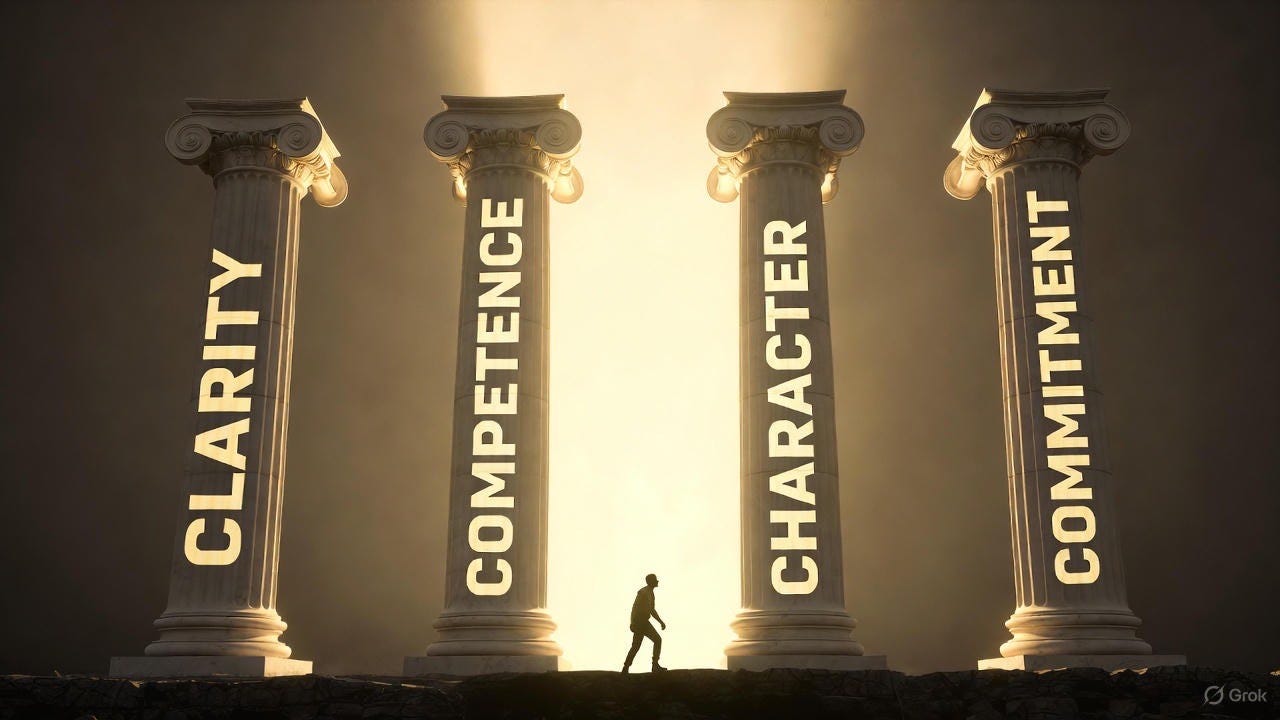
The Four Pillars of AI-Augmented Growth
PILLAR ONE: CLARITY - Know What You’re Actually Building
Most people approach AI tactically instead of strategically.
“How do I use AI to write this email?”
“Can AI help me with this report?”
All tactical questions. None of them address the fundamental issue: What capability are you trying to build?
Without clarity on that, every AI interaction is random. You have no way to tell if you’re moving forward or backward because you don’t know where you’re trying to go.
This is important! Before you touch AI for any task, answer three questions:
1. What capability does this task develop?
Not “what am I completing?” Instead, as “what skill does successfully doing this require?”
Example:
Bad: “Writing an email”
Good: “Clear communication under constraints, persuasive argumentation, audience awareness”
2. How does AI help me develop that capability faster or deeper?
Instead of “how can AI do this for me?” Ask “how can AI help me get better at this?”
Example:
Bad: “AI writes the email”
Good: “AI shows me multiple approaches, identifies gaps in my logic, reveals where I’m unclear”
3. Am I amplifying something real or faking something missing?
Be honest.
Example:
Amplifying: “I understand the argument, AI helps me refine it”
Faking: “I don’t understand this topic, hoping AI can make me sound like I do”
If you can’t answer all three clearly, stop. Get clear. Then proceed.
The Weekly Clarity Audit:
Can I articulate what I’m trying to become better at?
Do my AI interactions consistently develop those capabilities?
Can I recognize quality without AI telling me?
PILLAR TWO: COMPETENCE - Build Real Capability, Not Dependency
Every time you use AI, you’re either getting better at your craft or getting worse at it. There’s no neutral.
Here’s how you know the difference:
The Competence Test: Remove AI from your workflow for one week. Can you still perform at 70% effectiveness?
If yes: AI is amplifying real capability
If no: AI is replacing capability you never built
Actually do this test quarterly. Because here’s what happens over time:
Path A - Building Competence:
Month 1: 100% effective without AI, 130% with AI
Month 6: 120% effective without AI, 180% with AI
Result: AI amplifies growing capability
Path B - Building Dependency:
Month 1: 100% effective without AI, 130% with AI
Month 6: 70% effective without AI, 150% with AI
Result: AI replaces eroding capability
Same tool. Different trajectories. The only variable is how you use it.
The Competence Framework:
Before: Do I understand this problem well enough to evaluate solutions?
During: Am I learning why this works, not just that it works?
After: Can I explain what I learned and teach it to someone else?
If you’re not answering “yes” to most of these, you’re building dependency.
PILLAR THREE: CHARACTER - Own Your Choices
Here’s where Jordan Peterson’s insight becomes crucial:
Your future isn’t created in dramatic moments. It’s created in mundane moments of discipline.
The choice to do one more revision when “good enough” is whispering.
The choice to attribute AI assistance when nobody would know if you didn’t.
The choice to say “I don’t know” instead of letting AI fake it.
These micro-decisions seem insignificant. But they’re literally constructing your destiny.
Character isn’t built in the big moments. It’s revealed there. Character is built in the small moments when nobody’s watching.
Artificial Intelligence has created thousands of new “small moments” where your character is being tested.
Here’s what Christ told you about this:
“Whoever can be trusted with very little can also be trusted with much, and whoever is dishonest with very little will also be dishonest with much.” (Luke 16:10)
Every AI interaction is a “very little” moment.
How you handle these moments is who you are, or who you are becoming. Not who you say you are—who you actually are when nobody’s checking.

The Character Checkpoint:
Transparency: Would I be comfortable explaining exactly how I used AI for this?
Ownership: Can I defend every claim in this output?
Development: Did this make me better at my craft?
Standards: Did I hold this to my actual standards or accept AI’s first pass?
If you can’t check all these boxes, you’re compromising—and compromise compounds.
PILLAR FOUR: COMMITMENT - Build Systems, Not Habits
Habits fail under pressure. Systems persist.
Why? Habits rely on willpower. Systems rely on structure.
Good systems make the right choice the easiest choice. They build guardrails around your weakest moments. They create accountability when motivation fails.
The 30-Day Rise Challenge:
Week 1: Document Everything
Log every AI interaction:
What you were trying to accomplish
Prompts used
Output kept vs. discarded
Iterations made
What you learned
Goal: See your patterns
Week 2: Audit Your Trajectory
Review week 1 and ask:
Am I better at my core skills than 7 days ago?
Am I more capable or more dependent?
What shortcuts did I take?
Where did I compromise?
Goal: See your character
Week 3: Build Your Protocol
Create written rules:
Non-negotiables:
What you’ll ALWAYS do (e.g., “Iterate at least 3 times”)
What you’ll NEVER do (e.g., “Never submit without substantial revision”)
Quality standards:
What does “good enough” actually mean?
What’s your review process?
Attribution rules:
When do you disclose AI use?
How do you give credit?
Goal: See your system
Week 4: Stress Test Everything
Create challenging conditions:
Push a deadline
Face a hard problem
Work when tired
Then apply your protocol anyway.
Track where it held vs. where it broke.
Goal: See your commitment
Beyond the 30 Days:
Monthly: Review usage, audit your actual competence vs. dependency. Quarterly: Do the competence test (1 week without AI). Annually: Complete a full, honest retrospective on who you’re becoming
What’s Coming Next Changes Everything
You’ve been tracking manually. Documenting in spreadsheets. Relying on discipline to maintain the protocol.

But what if attribution could be immutable?
What if every contribution was permanently recorded? Every iteration preserved? Every decision traceable in an unchangeable ledger?
Not for surveillance. For accountability.
Imagine:
Immutable Attribution: You can’t retroactively claim you “mostly wrote it yourself” when the record shows otherwise.
Complete Provenance: Every version, every prompt, every iteration—preserved forever.
Verifiable Competence: Demonstrable evidence of capability growth over time.
Collaborative Clarity: When multiple people work with AI, everyone’s contributions are clear.
You can’t fake it when attribution is immutable. You can’t claim work you didn’t shape. You can’t rewrite history when the ledger is permanent.
That’s not a threat. That’s freedom.
Freedom from imposter syndrome—you can prove what you did. Freedom from attribution anxiety, because the record is clear. Freedom to build something worth scaling, because you know it’s real.
This isn’t theoretical. This is what we’re building, right now—behind the scenes. And it changes everything about how you approach AI-assisted work.
The Question You’ve Been Avoiding
Look at your last 30 days of AI use honestly.
Are you proud of what you’ve built?
Would you be comfortable if every prompt, every output, every shortcut was made public and permanent?
If yes: You’re ready to RISE.
If no: You know what needs to change.
The Rise Commitment
I will use AI to amplify, not replace.
I will build competence, not dependency.
I will own my work, not claim what I didn’t shape.
I will document my journey, not hide my process.
I will rise into the person I was called to be, not settle for the person convenience makes easy.
This is the protocol. This is the standard.
Take the Challenge
Starting today, for the next 30 days:
Week 1: Document everything
Week 2: Audit honestly
Week 3: Build your protocol
Week 4: Stress test it
Then keep going.
Because this isn’t a 30-day program.
This is who you’re becoming.
The Final Question
If everything I am was amplified 100x, would the world be better or worse?
AI will amplify you either way. It will take who you are and scale it.
If you’re building something real, that’s powerful.
If you’re faking it, that’s catastrophic.
Is this someone worth amplifying?
That’s the only question that matters.
And your answer determines whether you rise or fall.
Ready to rise? Take the 30-day challenge. Get inspired. Take action. Document everything. See who you’re becoming.
This article is part one of a three part series:
Part One: AI Doesn’t Make You Creative—It Exposes Whether You Ever Were
Part Two: Character at Scale: Why Your Integrity Matters More in an AI World
Part Three: The RISE Protocol: A Practical Framework for AI-Augmented Growth